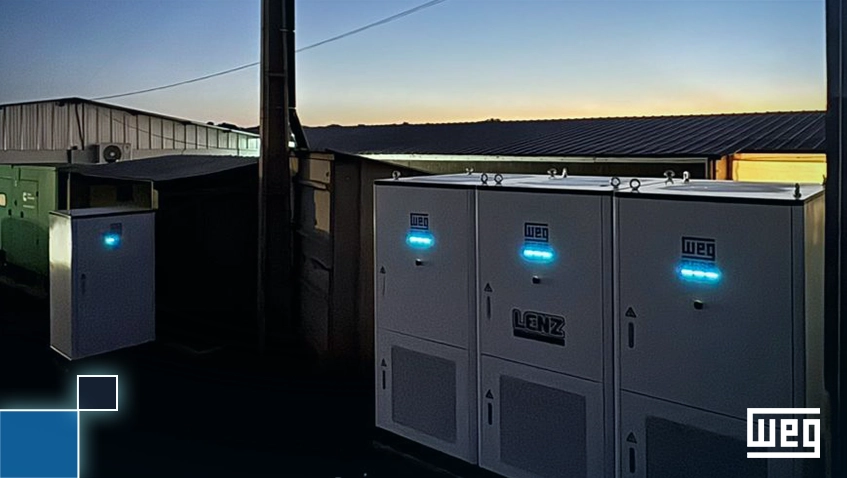
WEG announces the construction of a new manufacturing plant dedicated to the production of battery energy storage systems (BESS) in Itajaí, Santa Catarina. The facility will be the most advanced in the country within this segment and represents a strategic step forward in the company’s portfolio of energy transition solutions.
To enable the project, WEG secured financing of BRL 280 million through the BNDES More Innovation program, approved under the public call aimed at the transformation of strategic minerals for energy transition and decarbonization, carried out in partnership with Finep.
Construction of the new plant will begin shortly, with completion scheduled for the second half of 2027. The operation of the facility will generate approximately 90 new direct jobs. In addition, the new plant will expand WEG’s BESS production capacity up to 2 GWh per year, equivalent to 400 systems of 5 MWh, and will feature a high level of automation, including automatic and semi-automatic assembly lines, as well as the use of autonomous mobile robots for internal logistics.
The complex will also house a laboratory dedicated to product testing, development, and qualification, responsible for improving processes, ensuring quality control, and accelerating the development of new solutions. The infrastructure will also include an electrical substation for simulating real operating conditions.
“With this step, WEG expands its portfolio of high value-added solutions, developed and manufactured in Brazil, and contributes to strengthening energy security and the resilience of our grid. This investment is aligned with the strategic objective of positioning WEG and Brazil more competitively in the global energy transition landscape, mitigating risks and strengthening the country’s presence in this growing segment,” explains Alberto Kuba, President of WEG.
Battery energy storage systems are essential for the stability of power grids, especially with the growing share of renewable sources such as solar and wind. They enable energy to be stored during periods of low demand and released when needed, contributing to system reliability and reducing the risk of outages.