Caption: First Floating Photovoltaic Solar Plant in the archipelago, installed on the Xaréu Reservoir.
Credit: WEG Press Image
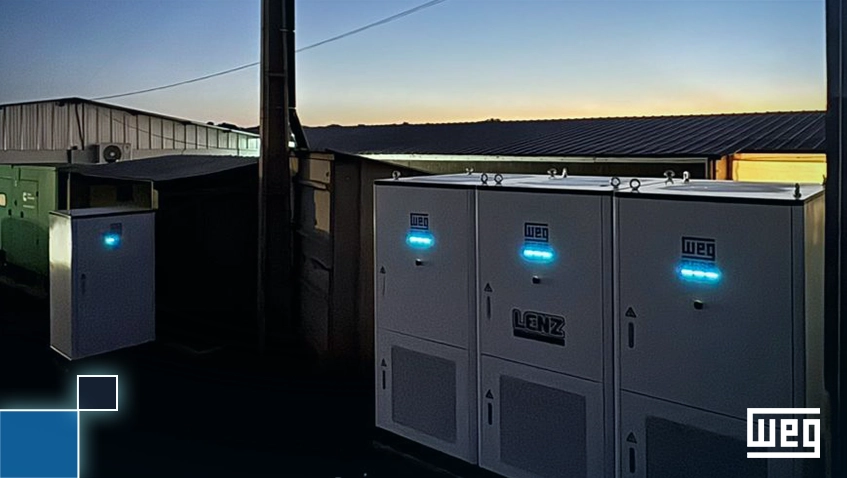
WEG will be responsible for the complete supply of the photovoltaic system and the energy storage system for the Noronha Verde (Green Noronha) project, an initiative led by Neoenergia that will transform Fernando de Noronha into the first inhabited oceanic island in Latin America to achieve 100% renewable energy generation. In addition to supplying the equipment, WEG will execute the entire technical and operational scope of the project, from system delivery to the commissioning required to ensure full integrated operation.
The initiative is part of the Mais por Noronha Program and involves the Federal Government, through the Ministry of Mines and Energy, and the Government of the State of Pernambuco. Announced today at the Forte Nossa Senhora dos Remédios, the project will receive more than 30,000 solar panels with a generation capacity of 22 MWp, along with an advanced Battery Energy Storage System (BESS) with 49 MWh, ensuring continuous clean energy supply at night or during periods of low solar incidence.
Licensed by the Pernambuco State Environmental Agency (CPRH), with approval from ICMBio, the federal conservation authority, the project will be executed in two phases: the first to begin operations by May 2026, and the second in 2027.
“The Noronha Verde project is a milestone for the national energy transition, and WEG is proud to contribute to yet another chapter in Fernando de Noronha’s sustainable development. Our expertise in integrated solutions enables us to deliver state-of-the-art technology, engineering, and execution for large-scale projects, promoting sustainability and innovation in Brazil,” highlights Daniel Godinho, WEG’s Director of Sustainability and Institutional Relations.
“The Noronha Verde is an unprecedented sustainability project for the island. Given its importance, we selected suppliers with proven experience. WEG’s delivery record and its history in the archipelago provide the confidence required for a project of this magnitude,” reinforces Eduardo Capelastegui, CEO of Neoenergia.
During the project launch ceremony, the first Floating Photovoltaic Solar Plant in the archipelago was also inaugurated, installed on the Xaréu Reservoir. The project included WEG’s complete photovoltaic system. With an investment of R$ 10 million, through Neoenergia Pernambuco’s Energy Efficiency Program (regulated by ANEEL), the floating plant has a capacity of 622 kWp and is expected to generate 1,083 MWh/year, enough to supply about 30% of the energy consumption of Compesa and avoid 717 tons of CO₂ emissions annually.
The launch of the project that will decarbonize Fernando de Noronha comes at a strategic moment for Brazil, on the eve of COP30. The initiative reinforces WEG and Neoenergia’s commitment to the global climate agenda and positions both companies as key players in the energy transition, contributing for Brazil to present concrete results and leadership examples in clean energy during the conference.
WEG’s History in Fernando de Noronha
WEG’s presence in Fernando de Noronha has been marked by pioneering initiatives in clean energy and sustainable mobility.
- In 2015, the company supplied the photovoltaic system for the island’s first solar power plants, Noronha I and II, which met up to 10% of the archipelago’s electricity demand. The project was also carried out in partnership with Neoenergia;
- In 2019, WEG supported the electric mobility project, enabling the installation of charging stations and the operation of electric vehicles in partnership with Neoenergia, eiON, CPqD, and Renault.
With the supply of systems for the Noronha Verde project and for the first floating photovoltaic plant in the archipelago, WEG reinforces its long-term commitment to sustainability and innovation in Fernando de Noronha, consolidating the island as a national and international reference in clean energy.