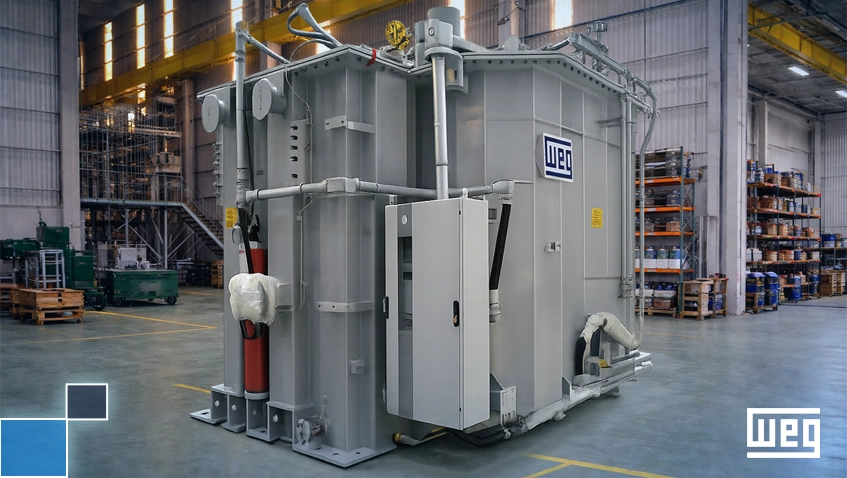
For certain industrial applications, such as high-current transformers, highly complex projects are required to meet critical operational demands. These cases include transformers designed for electric arc furnaces, ladle furnaces, rectifiers, and converters. In scenarios where it is essential to supply power at low voltage levels, transformers require customized designs.
Within this context, WEG carried out the uprating of a transformer for an electric arc furnace used in ferroalloy production. Originally manufactured in 1989, the transformer plays a fundamental role in converting electrical energy from the grid into thermal energy, enabling the transformation of metallurgical raw materials.
With an initial rating of 22 MVA, the equipment was redesigned to 33.4 MVA with a voltage of 14.2/0.258 kV. The improvements included replacing all windings (coils/insulation) using special cables, supplying a new on-load tap changer, drying the active part using the Vapour Phase (VP) system, as well as sandblasting and repainting the tank, in addition to tests and inspections according to NBR 5356 standards.
The use of continuously transposed conductors in transformers for special applications is essential, as it provides high short-circuit withstand capability. The system eliminates welds along the winding, ensuring uniform ohmic resistance and consistent positioning within the magnetic field.
Transformer uprating has become established as a strategic circular economy practice in both industrial markets and the power generation, transmission, and distribution sectors. This process consists of updating the equipment’s original design to increase load capacity while reusing high-value structural components from both economic and environmental perspectives, such as the tank, magnetic core, and accessories.
Instead of discarding an asset and purchasing a new one, engineering efforts focus on replacing the windings and insulation system, extending the transformer’s service life with performance equivalent to that of new equipment. This robustness drastically reduces the demand for critical raw materials, lowering the supply chain’s carbon footprint (circular economy) and optimizing customers’ capital expenditures (CAPEX), aligning operational efficiency with global sustainability goals.
Another important aspect is the delivery time, which in refurbishment processes tends to be significantly shorter compared to acquiring new equipment. This agility helps reduce operational downtime and provides greater predictability in activity planning.
In this way, transformer revitalization has become a commercially advantageous, reliable, and strategic alternative that optimizes investments and sustainability.


